Personal Planning: Simplify Your Week with Proven Routines

Most weeks feel like a blur of half-finished tasks, forgotten priorities, and that nagging sense that you’re always reacting instead of choosing. You’re not disorganized. You’re just missing a structure that works with your life, not against it. Personal planning is the practice of intentionally deciding how to spend your time and energy before the week decides for you. It’s not about rigid schedules or color-coded spreadsheets. Done right, it’s the single most effective way to reduce mental load, protect your energy, and actually enjoy your days instead of just surviving them.
Table of Contents
- Understanding personal planning
- Key elements of effective personal planning
- Common pitfalls and how to avoid them
- Personal planning in action: Sample weekly routine
- Our take: Why simplicity beats perfection in personal planning
- Ready to simplify your week? Try AI-powered personal planning
- Frequently asked questions
Key Takeaways
| Point | Details |
|---|---|
| Personal planning explained | Personal planning creates structure in your week by intentionally setting goals and routines. |
| Less stress, more focus | Routines cut down on daily decisions so you feel less overwhelmed and get more done. |
| Simple beats complicated | Focus on easy-to-maintain routines instead of chasing perfection for the best results. |
| Progress over perfection | It’s okay to miss a day—adapt your plan as your needs change. |
Understanding personal planning
Personal planning is often confused with keeping a to-do list or syncing a calendar. But those tools are reactive. Personal planning is proactive. It means looking ahead, making deliberate choices about your time, and building routines that support your goals before the chaos of daily life takes over.
At its core, personal planning incorporates goal setting, time allocation, and routine building, which collectively ease mental load. These three components work together. Goal setting gives you direction. Time allocation turns intentions into scheduled action. Routine building removes the daily friction of figuring out what to do next.
Here’s how personal planning compares to simpler alternatives:
| Approach | Focus | Mental load | Flexibility |
|---|---|---|---|
| To-do list | Tasks | High | Low |
| Calendar | Events | Medium | Medium |
| Personal planning | Time, goals, habits | Low | High |
The difference isn’t just organizational. It’s psychological. When you know what’s coming and why it matters, your brain stops running background stress loops about everything you might be forgetting.
The key benefits of personal planning include:
- Reduced overwhelm by breaking the week into manageable, purposeful chunks
- Increased productivity because you’re working from intention, not impulse
- More free time since planning prevents wasted hours on low-priority tasks
- Better energy management by aligning demanding work with your peak focus hours
“A plan is not a prison. It’s a permission slip to stop worrying and start doing.”
Think of personal planning as the difference between packing a bag the night before a trip versus scrambling at the door. The outcome might look similar from the outside, but the internal experience is completely different. One leaves you calm and ready. The other leaves you frazzled before you’ve even started.
Key elements of effective personal planning
Knowing what personal planning is and actually doing it well are two different things. The good news is that the practices that make it work are simple, learnable, and immediately useful.
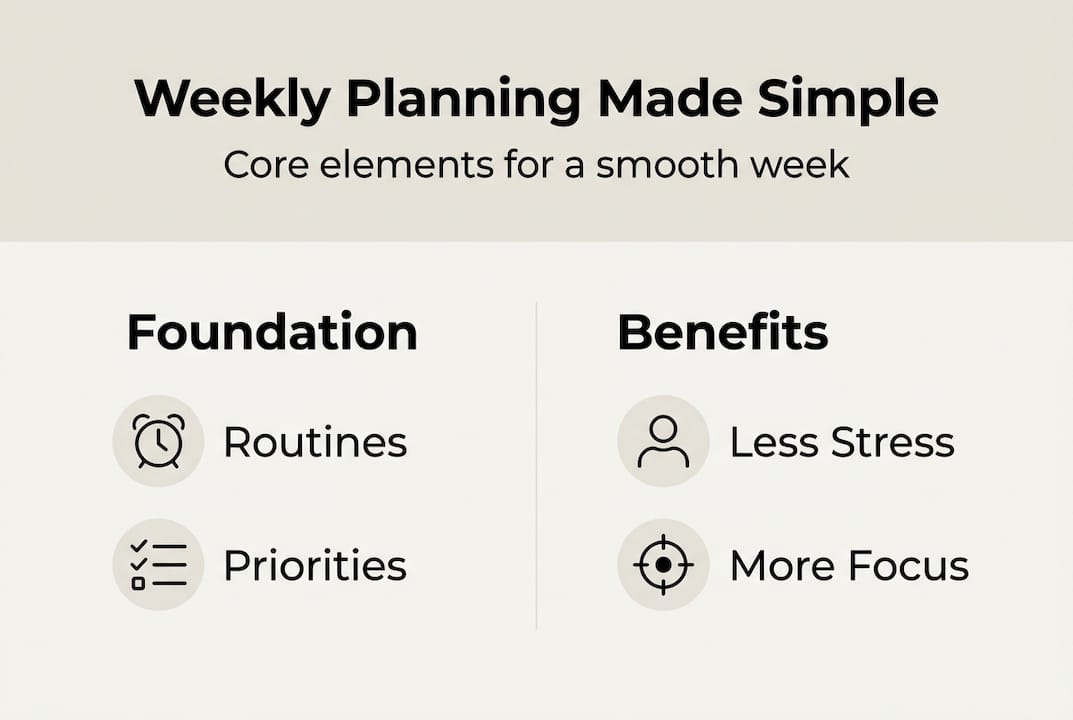
Consistent routines are the foundation. Reducing decision fatigue through routines significantly boosts follow-through because you’re not burning mental energy on choices that don’t need to be made fresh every day. When your morning routine is automatic, you arrive at your first real task with a full tank.

Here’s a breakdown of the three most effective personal planning techniques:
| Technique | What it does | Best for |
|---|---|---|
| Prioritization | Identifies what matters most | Weekly goal setting |
| Time blocking | Assigns tasks to specific time slots | Deep work and focus |
| Weekly reflection | Reviews progress and adjusts plans | Continuous improvement |
The format you use matters less than the consistency you bring to it. Here are the three most common approaches:
- Digital planners (apps like Notion, Google Calendar, or weekraft) offer flexibility, reminders, and easy editing.
- Analog journals provide a tactile, distraction-free experience that many people find more satisfying and memorable.
- Hybrid approaches combine both, using digital tools for scheduling and paper for reflection and creative thinking.
None of these is objectively better. The best format is the one you’ll actually use. If a beautiful notebook makes you excited to plan, use it. If you need your phone to remind you, lean digital.
Pro Tip: Use Sunday evenings for a quick 15-minute weekly review. Look at what worked, what didn’t, and set your top three priorities for the coming week. This single habit can transform how Monday morning feels.
The goal of all these techniques is the same: to make your week feel designed rather than accidental. When you block time for the things that matter, they actually happen.
Common pitfalls and how to avoid them
Even people who genuinely want to plan better often fall into the same traps. Understanding these pitfalls in advance means you can skip the frustration and go straight to what works.
The most common mistakes include:
- Overcomplicating the plan. The majority abandon planning routines due to over-complicating the process or setting unrealistic expectations. A plan with 40 items is not a plan. It’s a wish list.
- Underestimating time. Most people are optimistic about how long tasks take. Build in buffer time and you’ll stop feeling behind before noon.
- Neglecting flexibility. Life changes. Your plan should too. A plan that can’t bend will break.
- Treating a missed day as failure. This is the most common reason people quit entirely. One off day doesn’t erase your system.
Simple fixes that actually work:
- Start with just two or three priorities per week, not ten.
- Review and adjust your plan every few days, not just at the start of the week.
- Focus on your top priorities first, before anything else gets your attention.
Pro Tip: If you miss a day, treat your plan as a compass, not a calendar. A compass still points north even if you took a detour. You don’t restart from zero. You just reorient.
“Sustainable systems beat perfect ones every time. A plan you follow 80% of the time is infinitely more valuable than a flawless plan you abandon after three days.”
The underlying principle here is that planning is a skill, not a personality trait. You get better at it by doing it imperfectly, reflecting, and adjusting. Perfectionism isn’t discipline. It’s just a more sophisticated form of avoidance.
Personal planning in action: Sample weekly routine
Seeing a real example makes the whole concept click. Here’s a flexible weekly planning template you can adapt to your lifestyle, whether you work from home, manage a family, or balance school and work.
A basic planning structure can measurably increase follow-through and reduce stress, which is exactly what this template is designed to deliver.
- Sunday evening (15 minutes): Review the past week. Note what you completed and what carried over. Set your top three priorities for the week ahead.
- Monday morning (10 minutes): Confirm your schedule for the day. Identify your one most important task and block time for it first.
- Tuesday through Thursday: Follow your time blocks. Protect deep work periods from interruptions. Handle reactive tasks like email in designated windows.
- Friday afternoon (10 minutes): Do a quick end-of-week check. Celebrate small wins. Move incomplete items forward intentionally, not by accident.
- Weekend: Protect at least one full day for rest, family, hobbies, or whatever recharges you. Recovery is part of the plan, not a break from it.
This template works for different lifestyles with small adjustments. Parents might shift the Sunday review to after the kids are in bed. Students might add a midweek check-in before assignments pile up. Remote workers might use the Friday review to mentally close the workweek and protect their weekend.
Pro Tip: Use this template as a starting baseline, not a finished product. After two weeks, you’ll know which parts fit naturally and which need tweaking. Your plan should evolve as your habits and circumstances change.
The key insight here is that adaptation is the point. A plan that changes with your life is a living system. A plan that stays rigid until you abandon it is just a document.
Our take: Why simplicity beats perfection in personal planning
Here’s something most productivity advice gets wrong: more detail does not mean more control. In fact, the opposite is usually true. The more complex your planning system, the more energy you spend maintaining the system instead of living your life.
We’ve seen this pattern repeatedly. Someone discovers personal planning, gets excited, builds an elaborate color-coded system with subcategories and weekly themes and daily rituals. It works brilliantly for about nine days. Then one busy Tuesday derails everything, and the whole system feels broken.
Simple plans survive contact with real life. A three-priority week survives a sick kid or a surprise deadline. A 30-item master plan does not.
Perfectionism in planning is sneaky because it feels like ambition. But it’s actually fear. Fear that a simple plan won’t be enough. The truth is that a simple plan you follow consistently will always outperform a perfect plan you follow occasionally. Your planning system should be boring to maintain and exciting in its results. That’s the goal.
Ready to simplify your week? Try AI-powered personal planning
Building a personal planning habit takes intention, but it doesn’t have to take hours. If you’re ready to move beyond blank notebooks and forgotten calendars, technology can do a lot of the heavy lifting for you.
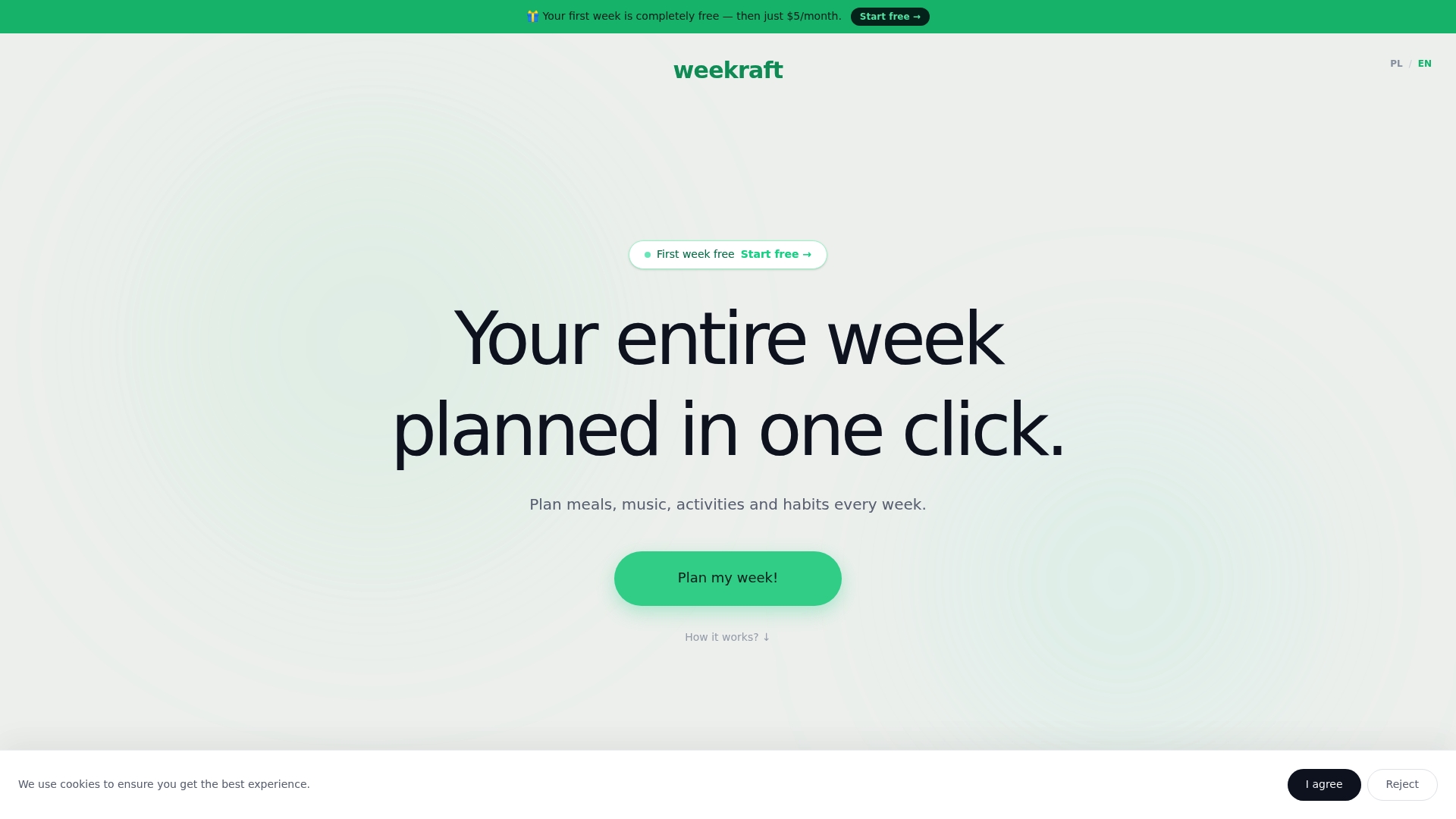
AI-driven planning routines can generate a fully personalized weekly plan in minutes, complete with meal suggestions, habit challenges, music recommendations, and daily goals tailored to your lifestyle. weekraft was built specifically to reduce the mental load of planning so you can spend your energy living the week, not designing it. Your first week is free, and after that it’s just $5 a month. Simple, affordable, and genuinely useful.
Frequently asked questions
What is the main goal of personal planning?
Personal planning helps you take control of your time and reduce stress by structuring routines around what matters most. As research confirms, goal setting and routine building collectively ease mental load and improve follow-through.
Can personal planning help reduce decision fatigue?
Yes. Structured routines mean you make fewer decisions each day, which shrinks mental overload and sharpens your focus. Routines reduce fatigue by automating low-stakes choices so your brain stays fresh for what matters.
What’s a simple way to start personal planning?
Start by setting one to two priorities each week and building a basic routine around them. A basic planning structure measurably increases follow-through even when you start small.
What if I miss a day in my plan?
Treat your plan as a guide, not a rulebook, and resume where you left off without stressing about perfection. Most people quit their planners not because planning failed, but because they expected it to be flawless.