Build a weekly routine for productivity and balance

Most people don’t struggle because they lack motivation. They struggle because Sunday night arrives and the week ahead feels like a pile of loose puzzle pieces with no picture on the box. Meals unplanned, workouts skipped, personal goals quietly shelved again. The result is a week that happens to you instead of one you actually shape. A structured weekly routine changes that. It gives you a framework that protects your energy, sharpens your focus, and makes room for the things that genuinely matter. This guide walks you through the tools, design process, habit integration, and troubleshooting you need to build a routine that sticks.
Table of Contents
- What you need to start your weekly routine
- How to design your ideal weekly routine
- Including fitness, entertainment, and personal development
- Common pitfalls and expert troubleshooting
- The surprising truth about perfect weekly routines
- Turn your weekly routine into an effortless habit
- Frequently asked questions
Key Takeaways
| Point | Details |
|---|---|
| Start with priorities | Block out your immovable commitments before adding flexible tasks to your weekly routine. |
| Balance structure and flexibility | Mix predictable blocks with adaptable time for lower stress and higher productivity. |
| Include health and growth | Build in fitness, entertainment, and personal development for a more fulfilling routine. |
| Review and adjust regularly | Make short, frequent adjustments instead of waiting for things to break down. |
What you need to start your weekly routine
Having set the stage for why structure matters, let’s get concrete with what you need to launch your weekly routine. The good news is that you don’t need an elaborate system. You need the right tools and a clear starting point.
Here’s a quick look at the most common planning tools and what each one does best:
| Tool | Best for | Key feature |
|---|---|---|
| Paper planner | Visual thinkers | Tactile, distraction-free |
| Digital calendar | Shared schedules | Reminders, recurring events |
| Planning app | Habit tracking | Gamification, analytics |
| Sticky notes | Quick captures | Portable, low friction |
| Spreadsheet | Custom systems | Full flexibility |
You don’t need all five. Pick one primary tool and one backup for quick captures. Most people do well with a digital calendar for structure and a small notebook for daily notes.
Before you fill in any time slots, identify your non-negotiables. These are the fixed anchors of your week: work hours, school pickups, medical appointments, recurring commitments. Defaults dominate behavior, and layering your fixed commitments first is what makes routines actually stick. Everything else fits around these anchors.
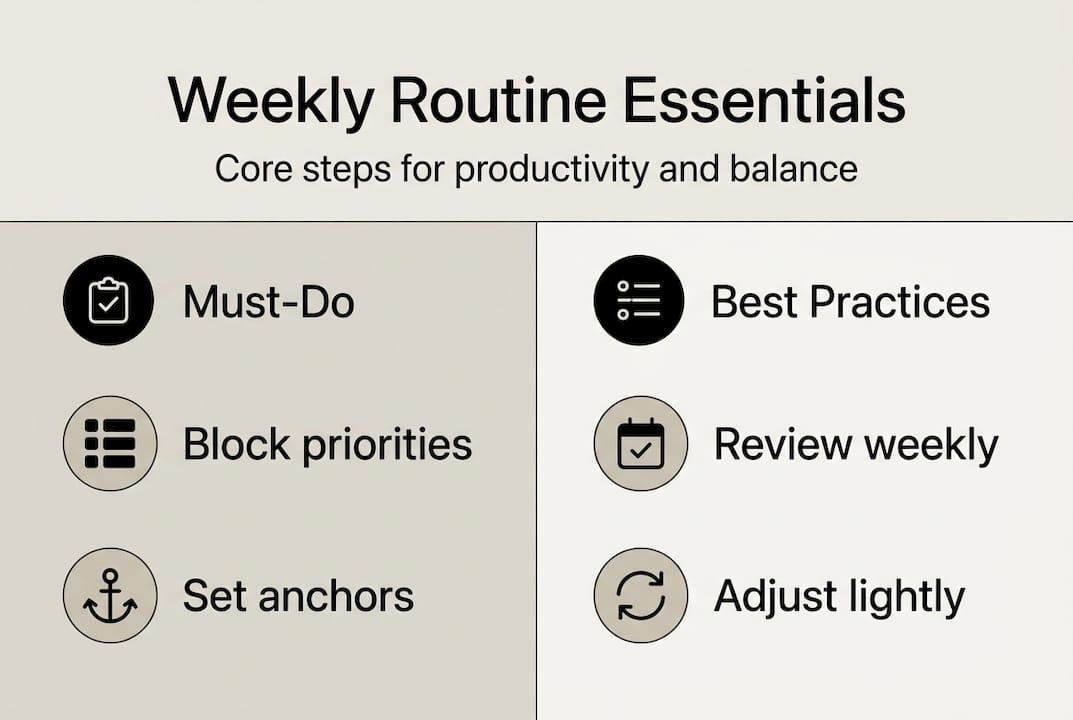
Once your anchors are placed, look at what’s left. You’ll likely find more open time than you expected. That’s where your meals, workouts, learning blocks, and downtime live. Use weekly planning templates to map this visually before committing to anything.
Here’s what your starter toolkit should include:
- A primary calendar or planner (digital or paper)
- A weekly template with time slots pre-labeled
- A short list of your non-negotiable weekly commitments
- A capture tool for ideas and tasks that pop up mid-week
- A consistent review slot (more on this shortly)
Pro Tip: Spend five minutes at the end of each workday writing down your top three priorities for tomorrow. This small habit closes mental loops and means you wake up with a clear direction instead of scrambling to figure out where to start.
How to design your ideal weekly routine
With your tools ready, it’s time to design a routine that actually fits your real life, not an idealized version of it.
Follow these steps to build your structure from the ground up:
- Block immovable events first. Add every fixed commitment to your calendar before anything else. Work hours, recurring meetings, family obligations. These are your walls.
- Identify your peak energy windows. Most people have two to three hours in the morning when focus is sharpest. Reserve these for your most demanding work.
- Layer deep work blocks. Energy-aligned priority work and time blocking create the most effective structure. Schedule your hardest tasks during your peak hours.
- Add flexible slots. Leave buffer time between blocks. Life interrupts. Buffers keep your day from collapsing when it does.
- Assign day themes. Group similar tasks by day to reduce context switching. For example, Monday for planning, Tuesday and Thursday for deep creative work, Wednesday for meetings.
- Build in a shutdown ritual. End your workday with a consistent closing routine: review what you finished, note what carries over, and close your tabs.
Cal Newport’s time blocking uses day theming, 90-minute deep work sessions, and a shutdown routine to create a system that protects focus without requiring willpower. The shutdown ritual is especially powerful because it signals to your brain that work is done, making it easier to actually rest.
Here’s how rigid and flexible approaches compare:
| Approach | Pros | Cons | Best for |
|---|---|---|---|
| Rigid routine | High predictability | Breaks under pressure | Stable schedules |
| Flexible routine | Adapts easily | Can drift without anchors | Variable workloads |
| Hybrid (recommended) | Structured + adaptable | Requires weekly review | Most people |
The hybrid model wins for most people. You get the stability of a fixed skeleton with the breathing room to adjust without guilt.

Pro Tip: Every Sunday, spend ten minutes reviewing last week and sketching next week. Don’t overhaul everything. Just ask: what worked, what didn’t, and what one thing needs to shift? That’s it. Small adjustments weekly beat big redesigns monthly.
Including fitness, entertainment, and personal development
Now that your main structure is set, fill in the spaces with health, recreation, and self-improvement for a well-rounded week. A routine that’s all work and no play isn’t sustainable. It’s just a more organized form of burnout.
For fitness, spread your effort across the week rather than cramming it into two long sessions. Andrew Huberman’s Foundational Fitness protocol efficiently covers strength, hypertrophy, and endurance across a weekly plan without requiring hours at the gym every day. A practical split looks like this:
- Monday: Legs and lower body strength
- Tuesday: Cardio (zone 2, 30 to 45 minutes)
- Wednesday: Push muscles (chest, shoulders, triceps)
- Thursday: Rest or light walk
- Friday: Pull muscles (back, biceps)
- Saturday: Long cardio or recreational sport
- Sunday: Full rest or gentle stretching
For personal development, small and consistent beats long and sporadic. A 20-minute reading block before bed, a 15-minute journaling session in the morning, or one online course module during lunch adds up fast. Use personal development trackers to log streaks and stay accountable without turning growth into a chore.
Entertainment deserves intentional scheduling too. Passive scrolling fills every gap if you let it. Instead, pick specific times for shows, music, or social media and treat those slots as real appointments. Intentional leisure actually feels more restorative than mindless consumption.
“A transition ritual between work and personal time, even something as simple as a short walk or five minutes of stretching, signals your nervous system that one mode is ending and another is beginning. This mental closure is what makes rest actually restful.”
Pro Tip: Batch your entertainment. Instead of checking social media six times a day, give yourself two dedicated 20-minute windows. You’ll enjoy it more and lose less time to the scroll.
Common pitfalls and expert troubleshooting
A well-planned routine means little if you’re stuck in all-or-nothing traps. Here’s how to get back on track when things go sideways.
The most common mistakes people make when building a weekly routine:
- Overplanning. Filling every hour leaves no room for reality. Aim for 70% scheduled, 30% open.
- Never reviewing. A routine without a weekly check-in slowly drifts into irrelevance. You stop following it and blame yourself instead of the system.
- Ignoring energy rhythms. Scheduling deep work at 3 PM when you’re naturally foggy is a setup for frustration. Map your energy first, then your tasks.
- All-or-nothing thinking. Missing one workout or one planning session doesn’t mean the week is ruined. One missed block is just one missed block.
- Copying someone else’s routine. Templates are starting points, not blueprints. Your life, energy, and goals are different.
Expert advice consistently points in one direction: consistency beats perfection for sustainable routines. Structure and spontaneity both matter. A routine that allows for flexibility is one you’ll actually keep.
Here’s what to do when your routine breaks down:
- Don’t wait for Monday to restart. Resume the next available slot.
- Run a five-minute “what broke” review. Was it overplanning, an unexpected event, or low energy?
- Adjust one thing, not everything. Changing your whole system after one bad week creates instability.
Statistic callout: Defaults dominate behavior. Most routines fail from complexity, not laziness. Simpler systems with fewer decisions outperform elaborate ones almost every time.
End-of-day shutdown routines psychologically close open loops, reducing the mental load you carry into your evening. When your brain knows the day is officially done, it stops rehearsing unfinished tasks. That’s not a soft benefit. That’s the difference between restful sleep and lying awake making mental to-do lists. Use weekly routine troubleshooting resources to diagnose what’s not working before scrapping the whole plan.
The surprising truth about perfect weekly routines
Here’s something most productivity content won’t tell you: the people with the most effective weekly routines aren’t the ones who follow them perfectly. They’re the ones who return to them fastest after falling off.
Perfection is genuinely the enemy of progress here. A rigid, flawless routine is fragile. One unexpected meeting, one sick kid, one bad night’s sleep, and the whole thing collapses. What works in real life is a routine built like a framework, not a finish line. It has shape and direction, but it bends without breaking.
The most sustainable approach we’ve seen is brief, regular adjustment. A ten-minute Sunday review beats a two-hour monthly overhaul every single time. Small tweaks keep the system aligned with your actual life instead of the life you planned for three months ago. Custom routine templates can give you a flexible starting point that you refine over time rather than rebuild from scratch. The goal isn’t a perfect week. It’s a slightly better one, consistently.
Turn your weekly routine into an effortless habit
Now that you know the why and how of solid weekly routines, here’s how to make them truly stick.
Building a routine from scratch takes mental energy. Maintaining one takes even more, especially when life gets unpredictable. That’s where having a smart system in your corner changes everything.
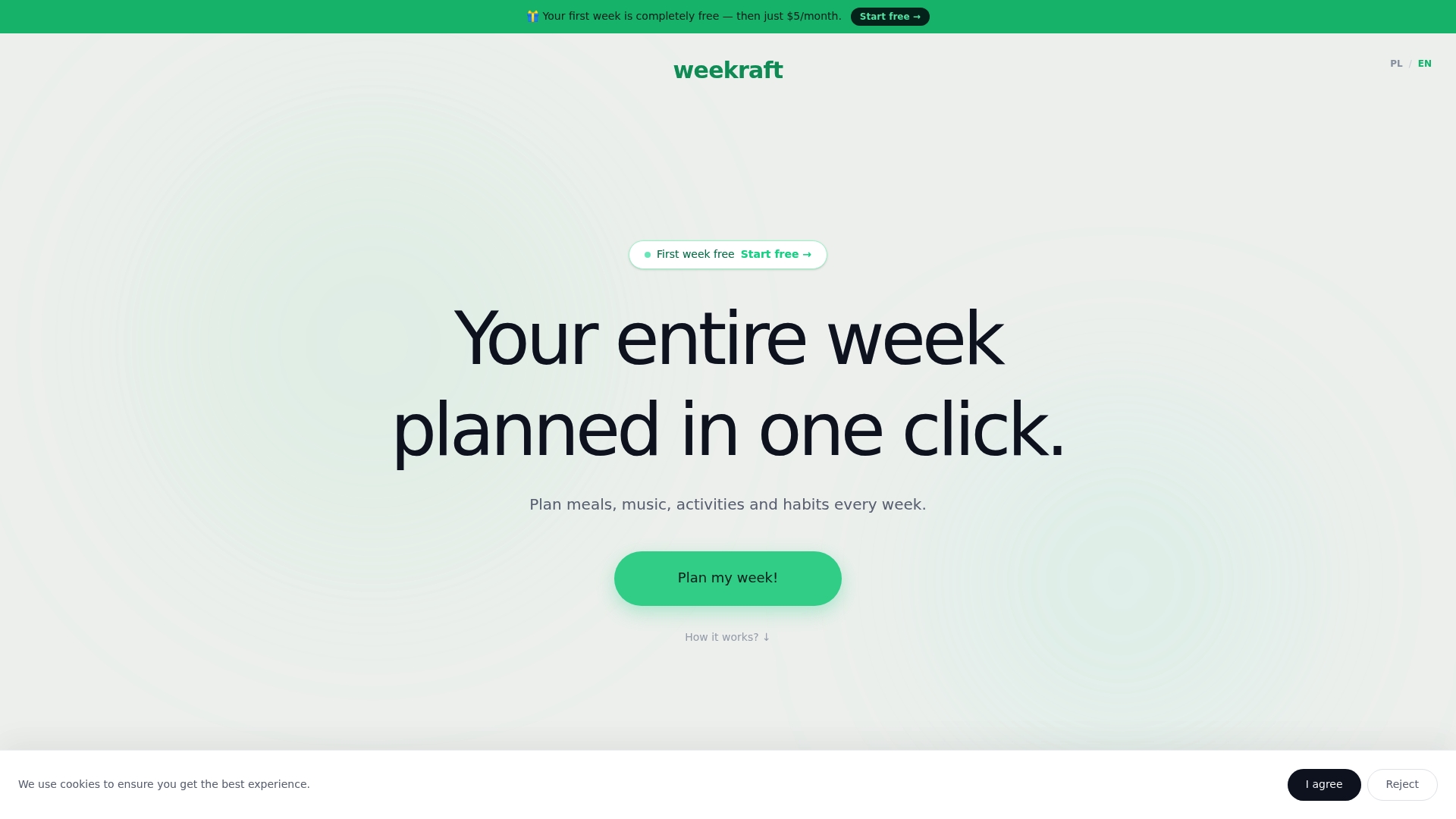
Weekraft is an AI-powered weekly life planner that generates a personalized plan for your week in minutes, covering meals, habits, music, fitness, and daily challenges. It removes the guesswork and adds a layer of gamification that makes showing up feel rewarding instead of obligatory. Your first week is completely free, and after that it’s just $5 a month. If you’ve been meaning to get organized but keep putting it off, this is the lowest-friction way to start.
Frequently asked questions
How long does it take to build a lasting weekly routine?
Most people establish a functional weekly routine in 3 to 4 weeks. Brief, regular review is more effective than long, infrequent planning sessions, so consistency in your Sunday check-in matters more than getting everything right from day one.
What’s the difference between daily and weekly routines?
A weekly routine provides structure for long-term goals and recurring activities, while daily routines manage specific tasks and moment-to-moment habits. Layering a recurring weekly structure helps you manage priorities across the full week rather than just reacting to each day.
How do I avoid burnout when sticking to a routine?
Allow for flexibility, balance work and leisure, and focus on consistency over perfection. Consistency over perfection is the core principle, and routines that include both structure and spontaneity tend to last far longer than rigid ones.
Can I change my routine if my schedule changes weekly?
Absolutely. You should adjust your routine to fit life’s changes while keeping key priorities consistent. Balancing structure and spontaneity prevents burnout and keeps your system relevant even when your week looks different from the one before.